Every year, around the same time, something shifts. The days get shorter. The light goes thin and slanted in a way that feels almost mournful. And for a lot of people — more than you’d think — that shift doesn’t just feel aesthetic. It lands inside them like a weight that wasn’t there before.
That’s not weakness or sensitivity or being dramatic — these can be early seasonal affective disorder symptoms experienced by millions of people each winter. For millions of people, it’s seasonal affective disorder — a real, diagnosable form of depression that follows the calendar with almost uncanny precision. It comes in the fall. It deepens through winter. And then, usually, it lifts.
Understanding seasonal affective disorder symptoms, why they happen, and what actually helps — that’s the whole point of this. Because too many people spend years assuming they just “hate winter” when what they have is a treatable condition.
What Are Seasonal Affective Disorder Symptoms and How SAD Affects Mental Health
Seasonal affective disorder is classified as a subtype of major depressive disorder — or, in some cases, bipolar disorder — with a seasonal pattern. The defining feature is timing. Episodes begin and end at roughly the same time each year, most commonly starting in late fall and resolving by spring or early summer.
There’s also a less common summer-pattern version, where depression arrives with the heat and long days rather than the dark. But the winter form is far more prevalent, and it’s the one most people are referring to when they talk about SAD
It’s worth being clear: this is not just “winter blues.” The winter blues are real too — low energy, a little more desire to stay home, general sluggishness. But seasonal affective disorder is significantly more disruptive. Recognizing seasonal affective disorder symptoms early can help people start treatment before winter depression becomes severe. It interferes with work, relationships, daily functioning. It doesn’t just make winter less enjoyable. For some people, it makes winter nearly unlivable.
Seasonal Affective Disorder Symptoms: What to Watch For
Seasonal affective disorder symptoms often develop gradually as daylight decreases during fall and winter. The seasonal affective disorder symptoms overlap significantly with major depression, which makes sense — it is a form of major depression. But there are some features that tend to be particularly characteristic of the winter-pattern version:
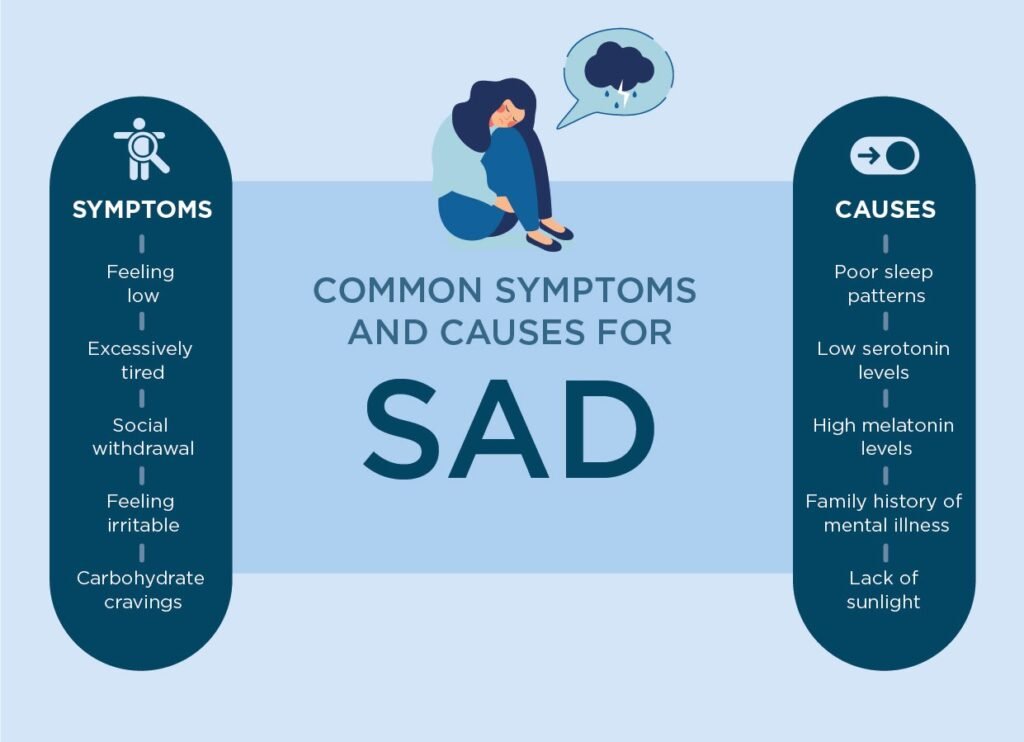
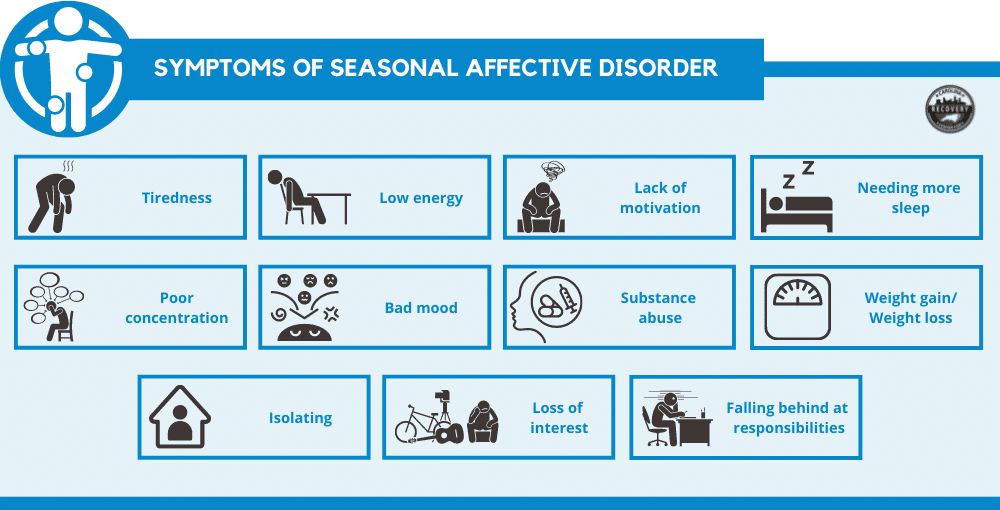
• Persistent low mood, most days — heavier than typical sadness, more like a settled gray
• Profound fatigue and low energy that doesn’t improve with sleep
• Sleeping much more than usual — hypersomnia rather than the insomnia more typical of non-seasonal depression
• Increased appetite, especially for carbohydrates and sugar — the body craving something it associates with warmth or energy
• Weight gain through the winter months
• Difficulty concentrating, brain that feels slow and heavy
• Withdrawal from social situations, cancelling plans, avoiding people
• Feelings of hopelessness that seem to lift as spring approaches
That last one is actually diagnostically significant. The seasonal pattern — the reliable improvement — is part of what distinguishes SAD from other depressive conditions. It doesn’t make it less serious. But it does make it more predictable, which matters for treatment.
Many seasonal affective disorder symptoms are similar to clinical depression, so understanding the signs of depression in adults can help identify when professional mental health support is needed.
Why It Happens: The Causes of SAD
The causes of seasonal affective disorder aren’t completely settled science, but the leading explanations are compelling and biologically coherent.
Light is the central story. Many researchers believe reduced sunlight plays a major role in triggering seasonal affective disorder symptoms.
The human brain responds to light exposure in ways that regulate mood, sleep, and internal time-keeping. When light diminishes — as it does in winter, particularly at higher latitudes — those systems can be disrupted in vulnerable people.
The specific mechanisms being studied include:
• Serotonin — reduced sunlight may lead to reduced serotonin activity. Serotonin is a neurotransmitter closely linked to mood regulation, and it’s also a precursor to melatonin
• Melatonin — the hormone that regulates sleep-wake cycles. In winter, the body produces more melatonin, for longer periods. This can affect mood and contribute to that heavy, sleepy, sluggish quality that marks SAD
• Circadian rhythm disruption — the internal clock that governs when you feel awake and when you feel tired can be thrown off by changes in light. When those rhythms desynchronize, depression can follow
Geography matters. People who live farther from the equator — where winters are longer and darker — are significantly more likely to experience seasonal affective disorder symptoms. Moving latitude can actually change the severity of the condition.
There’s also a genetic component. SAD runs in families, and women are diagnosed at significantly higher rates than men, though men often have more severe episodes when they do occur.
How SAD Differs From General Winter Depression
This is worth its own section because the confusion is so common. Lots of people feel worse in winter. Reduced activity, less sunlight, more time indoors, holiday stress — those things affect mood for almost everyone. That’s not necessarily seasonal affective disorder
The differences that point toward SAD specifically:
• The timing is reliable — it begins and ends at approximately the same point each year, for at least two consecutive years by diagnostic criteria
• The severity is significant — it interferes with functioning, not just enjoyment
• It doesn’t track cleanly with external events — it arrives when the light changes, not when stressful things happen
• The symptom profile has specific features — particularly the hypersomnia, carbohydrate craving, and the reliable spring recovery
Someone who feels a bit flat each January but functions normally, then feels better in March, may be experiencing a mild seasonal sensitivity. Someone who spends November through February unable to get out of bed, withdrawing from everything, and feeling genuinely hopeless — that’s a different scale of problem.
In some cases, people experiencing seasonal mood changes may also notice anxiety-related issues, and learning about generalized anxiety disorder symptoms can help differentiate between anxiety disorders and seasonal depression.
Treatment: What Actually Works
This is the genuinely encouraging part. Seasonal affective disorder responds well to treatment. Early treatment can significantly reduce seasonal affective disorder symptoms before they become severe. Several approaches have solid evidence behind them, and they can be used individually or in combination.
Light Therapy
The most first-line treatment for winter-pattern SAD is light therapy, which involves sitting near a specially designed light box that emits bright, full-spectrum light — typically 10,000 lux — for around 20 to 30 minutes each morning.
This isn’t a regular lamp. The light intensity matters. The timing matters — morning exposure is generally more effective because it helps reset the circadian rhythm. Most people notice improvement within one to two weeks.
Psychotherapy
Cognitive Behavioral Therapy adapted for SAD — sometimes called CBT-SAD — has been shown to be effective, particularly for the thought patterns that depression builds. Behavioral activation (getting moving, engaging with life even when the impulse is to withdraw) is a significant component.
Medication
Antidepressants, particularly SSRIs, are prescribed for SAD when symptoms are significant or other treatments haven’t been sufficient. Some people take them seasonally — starting in early fall, tapering off in spring — rather than year-round. This is a decision to make with a doctor.
Lifestyle factors
These aren’t cures, but they’re genuine supports:
• Getting outside during daylight hours, even in winter, even when it’s overcast
• Exercise — consistent evidence that regular movement improves depressive symptoms including in SAD
• Maintaining social connection even when the pull to withdraw is strong
• Sleep hygiene — keeping a regular schedule, which helps stabilize circadian rhythms
• Being aware of the pattern and planning for it — adjusting workload, scheduling supports, telling people who need to know
When to Seek Help for Seasonal Affective Disorder
If you recognize the pattern — if the same months reliably bring the same darkness and you’ve been explaining it away as something else — it’s worth talking to someone. A GP or mental health professional can assess whether what you’re experiencing meets criteria for seasonal affective disorder and discuss treatment options.
Signs it’s time to stop waiting:
• The seasonal dip significantly affects your work, relationships, or ability to care for yourself
• You’ve experienced the pattern for at least two consecutive years
• You’re using alcohol or food to manage the feeling
• You’ve had thoughts of self-harm during the low seasons
• The anticipation of the season is itself causing anxiety — the dread arriving before the darkness does
If seasonal affective disorder symptoms appear every winter, seeking help early can make a significant difference.
Early treatment — ideally starting before the seasonal shift rather than waiting for symptoms to peak — is significantly more effective. If you know October is coming and you know what October does to you, that’s the time to act.
If seasonal depression begins triggering intense fear or sudden distress, understanding the difference between a panic attack vs anxiety can help individuals recognize when professional evaluation is necessary.
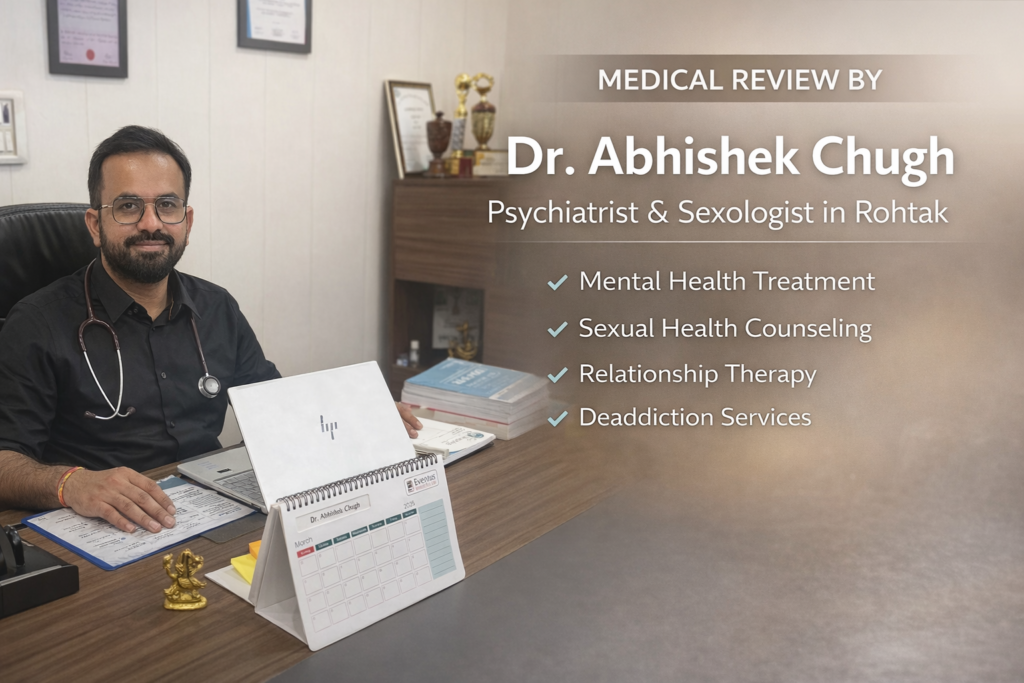
Medical Review by Dr. Abhishek Chugh – Psychiatrist & Sexologist in Rohtak
This article about seasonal affective disorder symptoms has been medically reviewed for its accuracy and reliability.
Dr. Abhishek Chugh is a renowned psychiatrist and sexologist in Rohtak with years of experience in treating mental health issues, sexual problems, relationship issues, and deaddiction therapy at the Mental and Sexual Health Clinic in Rohtak. He is a leading mental health expert in providing treatment and therapy for various mental and sexual issues in individuals and couples.
If you are suffering from mood swings and seasonal affective disorder symptoms, then it is recommended that you consult a professional and seek advice from a mental health expert to get proper treatment and therapy for better mental well-being and a healthy state of mind.
Conclusion
There’s something almost strange about a condition that keeps such precise appointments. But that predictability is also, in a way, something you can work with. Seasonal affective disorder gives you warning. You know when it’s coming. You can prepare, you can reach for support before you’re already in the bottom of it.
The seasonal affective disorder symptoms — the exhaustion, the craving, the withdrawal, the weight — are real and they’re treatable. Light therapy alone helps a significant proportion of people. For others, a combination of approaches changes the season entirely.
You don’t have to just endure winter. That’s the thing worth taking away from all of this. You don’t have to wait it out alone.
Frequently Asked Questions
1. How do I know if I have seasonal affective disorder or just winter blues?
The winter blues are mild and don’t significantly disrupt your functioning. Seasonal affective disorder symptoms are more intense, recurring each year at roughly the same time, and interfere with work, relationships, or daily life. If the pattern has repeated for two or more years and is genuinely disruptive, it’s worth a professional assessment.
2. Can seasonal affective disorder occur in summer?
Yes, though it’s much less common. Summer-pattern SADtends to involve insomnia, decreased appetite, and agitation rather than the hypersomnia and carbohydrate craving typical of winter SAD. The causes are less understood but may involve heat and humidity disrupting the nervous system.
3. Does light therapy actually work for SAD?
Yes — it’s the most evidence-supported first-line treatment for winter-pattern Seasonal affective disorder symptoms. Studies consistently show improvement with regular morning use of a 10,000 lux light box. Most people see results within one to two weeks. It works best when started early in the season, ideally before symptoms fully arrive.
4. Is SAD more common in certain locations?
Yes, significantly. Seasonal affective disorder symptoms is more prevalent at higher latitudes where winter days are shorter and darker — Scandinavia, northern Canada, parts of the northern US. Prevalence rates in Florida are dramatically lower than in Alaska, for instance. This geographic pattern is strong evidence for the light-based causal mechanism.
5. Can children and teenagers experience seasonal affective disorder?
Yes, though it’s less frequently diagnosed in younger people. SAD in children and adolescents can look like irritability, difficulty getting up for school, declining academic performance, and increased sleep needs in winter. If a child’s mood and functioning show a consistent seasonal pattern, a paediatric mental health evaluation is worthwhile.