That Feeling You Cannot Quite Name:-
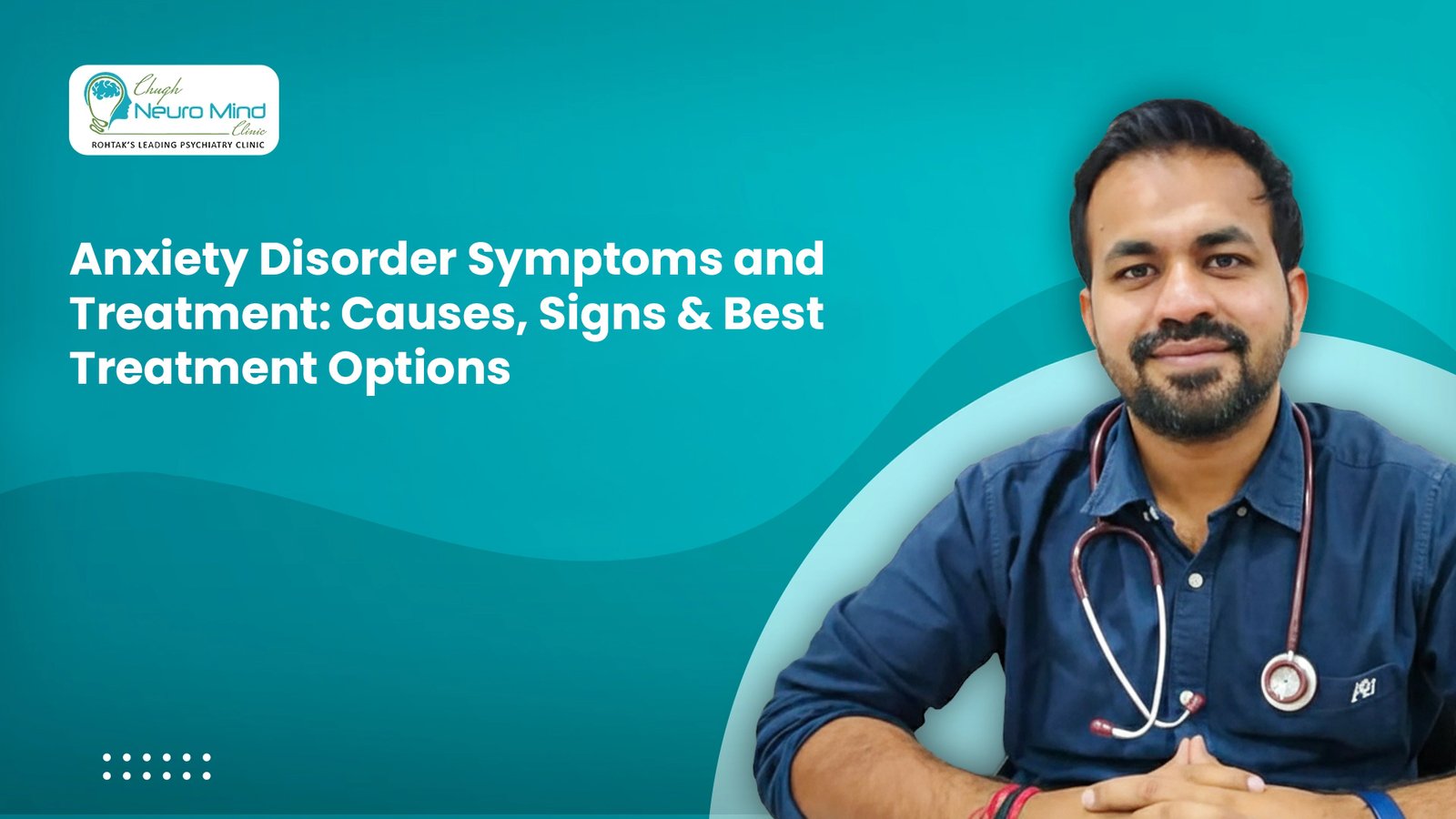
That feeling of constant worry, tightness in the chest, and a mind that never slows down may actually be anxiety disorder. Learning about the anxiety disorder symptoms and treatment is the first step towards recovery.
Understanding anxiety disorder symptoms and treatment is the first step toward recognizing when worry becomes a serious mental health condition.

While many people feel anxious, they do not know when it actually turns into a medical condition, calling it overthinking or stress. However, anxiety disorder is actually a medical condition that impacts an individual’s thoughts, emotions, as well as their health.
In this guide, we will discuss the anxiety disorder symptoms and treatment, the cause of anxiety disorder, as well as the best ways of managing anxiety disorder effectively.
Quick Overview of Anxiety Disorder:-
An anxiety disorder is a mental health problem that is described as excessive fear, worry, and physical changes like rapid heartbeats, muscles, and tiredness. The main types of anxiety disorders are generalized anxiety disorder, panic disorder, social anxiety disorder, and PTSD.
The best ways of treating anxiety disorder are cognitive behavioral therapy, medications like SSRIs and SNRIs, lifestyle changes, and reducing caffeine and alcohol intake. Early treatment of anxiety disorder helps improve the quality of life, as well as preventing future health complications.
Anxiety Disorder Symptoms and Treatment: What You Should Know
Anxiety disorder is not the nervousness before an exam or a job interview. That’s normal. That passes. What we’re talking about is when the anxiety doesn’t pass — when it becomes the background noise of your entire existence, when it interferes with your relationships, your work, your sleep, your body.
Clinically, it is a group of mental health conditions where fear and worry become so intense and persistent that daily functioning breaks down. The nervous system gets stuck in threat mode even when there’s no real threat.
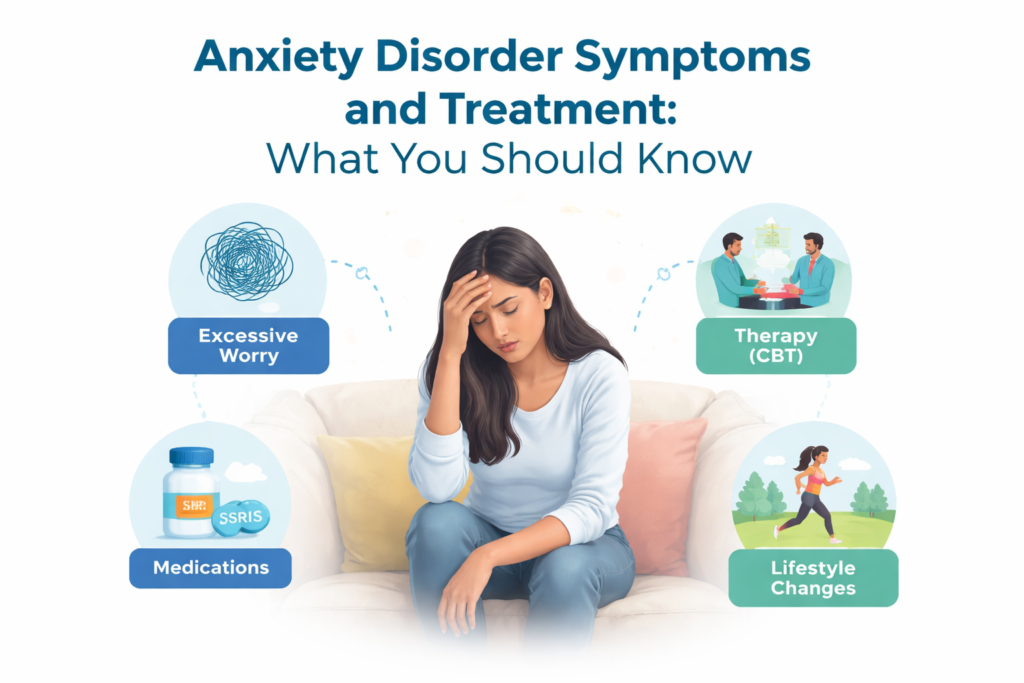
There are several types worth knowing:
• Generalized Anxiety Disorder (GAD) — Generalized Anxiety Disorder (GAD) involves persistent and excessive worry about everyday situations. You can learn more about generalized anxiety disorder symptoms and treatment in our detailed guide.
• Panic Disorder — sudden episodes of overwhelming fear with physical symptoms so severe they mimic a heart attack
• Social Anxiety Disorder — crippling fear of judgment or embarrassment in social situations
• OCD and related disorders — intrusive thoughts and compulsive behaviors to manage them
• PTSD — anxiety rooted in past trauma that keeps replaying in the present
Each one is real. Each one is treatable. None of them are personality flaws dressed in medical language. Understanding anxiety disorder symptoms and treatment helps people recognize when normal stress turns into a medical condition that requires professional help.
Symptoms of Anxiety Disorder: What It Actually Feels Like
Many people searching online for anxiety disorder symptoms and treatment often struggle to recognize their own experience in clinical descriptions. So let’s be specific about what anxiety actually feels like.
In the mind:
• Excessive worry about things you cannot control — the future, other people’s opinions, health, money
• Racing thoughts that won’t slow at night, cycling through the same fears
• Constant low-level dread, like waiting for something bad to arrive
• Difficulty concentrating — the mind keeps sliding off whatever you’re trying to focus on
• Irritability that surprises even you — snapping at people you love
In the body:
• Heart pounding or racing for no apparent reason
• Muscle tension — shoulders permanently near your ears, jaw clenched, back aching
• Stomach problems — nausea, IBS, digestive issues that doctors can’t explain
• Fatigue — not ordinary tired; bone-tired, the kind sleep doesn’t fix
• Shortness of breath, dizziness, sweating — especially during anxious episodes
People go to three different specialists before anyone mentions anxiety. The body symptoms are that convincing. Recognizing these physical and emotional signs is important when identifying anxiety disorder symptoms and treatment options early.
In many cases, anxiety can overlap with mood conditions, and recognizing the signs of depression in adults can also help identify when professional mental health support is needed.
What Causes Anxiety Disorder
What causes anxiety disorder is genuinely one of the most common questions people ask — and the honest answer is that there’s no single cause. It’s a convergence.
• Genetics — it runs in families; if a parent or sibling has anxiety, your risk is meaningfully higher
• Brain chemistry — imbalances in serotonin, dopamine, and GABA affect how threat signals are processed and regulated
• Childhood adversity — trauma, instability, or chronic stress early in life teaches the nervous system patterns it carries for decades
• Chronic adult stress — work pressure, financial worry, relationship strain sustained over time without relief
• Medical conditions — thyroid problems, heart arrhythmias, and hormonal changes can trigger or mimic anxiety
• Substances — caffeine, alcohol, certain medications; all significantly affect anxiety levels
Sometimes there’s no identifiable trigger. The anxiety just arrives. That doesn’t make it less real — it makes it more confusing, but not less real. Knowing these factors can help doctors decide the most effective anxiety disorder treatment for each individual. Understanding these causes helps doctors recommend the most effective anxiety disorder symptoms and treatment strategies for each patient.
Anxiety vs Panic Attack: What’s the Difference
One of the most common AEO questions people ask: anxiety vs panic attack — are they the same thing? This difference also plays an important role in determining the right anxiety disorder symptoms and treatment approach.
Anxiety is typically ongoing and diffuse. Worry that builds. A background state of tension and apprehension. It might be high for weeks and then slightly lower — but it doesn’t disappear.
A panic attack is acute and intense. It peaks within minutes, with a surge of physical symptoms — racing heart, difficulty breathing, chest pain, derealization, a terror that something catastrophic is happening right now. It is overwhelming and then it passes.
You can have panic disorder without generalized anxiety. You can have generalized anxiety without panic attacks. Or you can have both. This distinction matters for treatment — the approaches overlap but aren’t identical.
If you want to understand the symptoms in more detail, read our guide on panic attack vs anxiety and their key differences.
How to Treat Anxiety: Options That Actually Work
When discussing anxiety disorder symptoms and treatment, experts usually recommend a combination of therapy, medication, and lifestyle adjustments. Here’s what works:
Cognitive Behavioral Therapy (CBT) is the gold standard. It targets the thought patterns driving anxiety — the catastrophizing, the what-ifs, the worst-case spirals — and builds skills to challenge them. It takes time and real work. The research behind it is substantial.

Medications used effectively:
• SSRIs — sertraline, escitalopram, fluoxetine; first-line for anxiety; take 4-6 weeks to show full effect
• SNRIs — venlafaxine, duloxetine; another effective class
• Buspirone — non-habit-forming anti-anxiety medication; useful for long-term management
• Benzodiazepines — short-term, acute relief only; not for long-term use due to dependence risk
How to treat anxiety naturally — these are not replacements but genuine additions:
• Regular exercise — 30 minutes of walking has measurable neurological effects on anxiety
• Sleep consistency — anxiety and poor sleep feed each other in a vicious loop; fixing sleep matters enormously
• Reducing caffeine and alcohol — both are significant anxiety amplifiers that people underestimate
• Mindfulness and breathwork — not a cure, but a real tool for managing the acute physical response
Most people need a combination. Therapy plus lifestyle adjustment plus possibly medication. And it takes some calibration to find the right mix. A personalized plan combining therapy and lifestyle support is often the most effective anxiety disorder symptoms and treatment strategy.
When and Where to Seek Help
If anxiety is affecting your relationships, your sleep, your work, your body — you don’t need to wait until you’re in crisis to deserve help.
In Haryana, qualified psychiatric care is available. PGIMS Rohtak has a full psychiatry department. There are also experienced private psychiatrists practicing in both Rohtak and Hisar. If you’ve been looking for a best psychiatrist Rohtak or mental health support nearby, starting with a GP referral or directly booking with a psychiatry department is the most reliable path.
Online psychiatric consultations have also expanded access significantly — useful if stigma, distance, or scheduling makes in-person care difficult.
Conclusion
Understanding anxiety disorder symptoms and treatment can help people recognize their condition early and seek the right professional help.
Anxiety disorder is not a weakness. It is not overthinking. It is not something you can simply decide your way out of. It is a medical condition with neurological roots, real symptoms, and real treatment options that work for most people who access them.
The thing about anxiety is it lies to you. It tells you you’re broken, that things won’t change, that seeking help is pointless. None of that is true. The fact that you’re reading this is already a step. Start there.
Frequently Asked Questions
1. What causes anxiety disorder in people who had a normal childhood?
Anxiety doesn’t require trauma to develop. Genetics, brain chemistry, accumulated stress, and medical factors can all contribute even without obvious adverse experiences.
2. Can anxiety disorder go away without treatment?
Mild anxiety can improve with lifestyle changes. Clinical anxiety disorder rarely resolves completely without some form of intervention — and tends to worsen with time when untreated.
3. How is a panic attack different from a heart attack?
Both cause chest pain and shortness of breath. Panic attacks typically peak within 10 minutes and pass. A cardiologist can rule out cardiac causes — and it’s worth doing if you’re not sure.
4. Is anxiety medication safe long-term?
SSRIs and SNRIs are considered safe for long-term use. Benzodiazepines are not recommended for long-term use. Always discuss with your psychiatrist.
5. Where can I find a psychiatrist near Rohtak for anxiety treatment?
PGIMS Rohtak is the primary government option. Several private psychiatrists also practice in the area. Online telepsychiatry platforms can also connect you with qualified psychiatrists if in-person access is difficult.